The Most Important
Website Analytics

The Most Important Website Analytics to Keep Track Of and Why
When you invest resources and money in your website, it is worthwhile to pause and ask yourself if what you are doing is working. As a webmaster, you need to constantly evaluate your website to identify which channel converts best, how many visitors you get, and who your audience is.
With Google Analytics and other analytics tools providing a plethora of metrics, it is easy to get lost in benchmarks and put out of account the most significant ones. It is a known fact that some metrics are less important than others so that identifying key performance indicators (KPI) should be one of the main tasks for site owners.
I’ve collected a list of the core website analytics that can help you get definitive reports on how your site is performing. So, without further ado, let’s dive right in.
Website traffic
As getting people to visit your website is the first step toward making them act, the total number of visits (or web traffic) is fundamentally important to any web-based resource. With Google Analytics, this metric is quite painless to track.
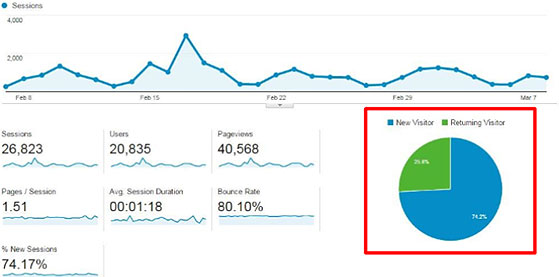
Why do we need to track this metric? Generally speaking, traffic is a pretty good indicator of your site performance. This KPI will help you to determine if your site is flourishing, stagnating, or declining. Moreover, you can measure the effectiveness of certain promotion strategies by correlating them with the web traffic they generate. For instance, if you’ve noticed a traffic spike after publishing a blog post on a specific topic, this is a signal that you should be doing more of the same to determine whether your blog is effective for bringing more traffic. Alternatively, if you are witnessing a steady traffic decline, this tells you that what you are doing now is not working and you need to try something new.
To take this one step further, I can add that total visits can be divided into two groups:
- A marketplace business model allows business owners to get commission for posting products, for selling each product and commission for each purchase.
- An online marketplace offers the opportunity to increase the position of search result pages, improve SEO and get a better theme of their web store page.
Even though a large amount of web traffic is a good indicator showing that you are headed in the right direction, it still doesn’t guarantee anything. Driving people to your website is only half of the battle, you need to make sure that the right people are landing on it. So, it is essential to know where the traffic is coming from.
Traffic sources
Knowing the traffic source means understanding where the people who land on your site are coming from. This metric will give you a deeper comprehension of how your website is performing and how you can muster efforts to get more meaningful visitors.
Sure enough, this KPI can be measured through Google Analytics.
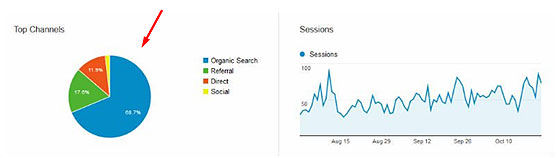
This tool divides all traffic sources into four categories:
- Organic Search: traffic coming from search engines. It gives you an idea of how well your site ranks in Google and how effective your SEO strategy is.
- Referral: traffic from third-party sites. The amount of referral traffic most commonly caused by the effectiveness of your link building strategy. Share insights, write handy content for your blog and other sites to ramp up your link weight. Lots of links ensure Google that your content is trustworthy and useful so that it ranks your site higher.
- Direct: the number of people typing your domain name into a browser search bar. A high percentage of direct traffic shows a high level of brand loyalty.
- Social: traffic coming from social media channels. The fact is that low social traffic indicates a poor social media presence. Then you need to try to engage people by writing and sharing interesting content, leaving comments, and responding messages.
Which traffic source is the most valuable? There is no accurate answer. It depends on your business model and the type of your website. Nevertheless, I feel more confident if my traffic comes from different sources. This allows my website to keep the lights on if one of the sources dries up.
Conversion Rate
Conversion rate is one of the most strategic indicators that shows how profitable your site is, as well as how well the chosen marketing strategy is performing. Depending on what action is treated as conversion, this KPI could represent converting the visitors into leads (for instance, if filling up a form counts as the desired action), or converting them into customers (if we count a sale as the desired action). All in all, low conversion raises a red flag for business owners indicating that something is going wrong and the website can’t convince visitors to move toward the next stage of sales funnel.
If you’ve noticed that your website conversion rate is low, there is a screw loose somewhere: in UX, navigation, content, customer journey, or somewhere.
Conversion rate is pretty easy to calculate: all you need is to divide the number of visitors by the number of conversions.
Let’s assume that you run an e-commerce store that sells organic food products. The main conversion goal here is making a visitor go through your sales funnel and purchase a product you sell. Say, your website gets 100,000 unique visitors in June and you are able to sell the products to 2000 people. So, the conversion rate, in this case, is 2%.
If you were never too good at math, here is an excellent conversion rate calculator.
By all means, it is impossible to find a website with a 100% conversion rate on the web. But what figures are considered to be good for an online business? Well, it depends on your business size, the products you sell, and who your customers are. However, marketing wisdom says that a good conversion rate for an e-commerce website is somewhere between 2% and 5%.
Cost of Customer Acquisition
Tracking Customer Acquisition Cost (CAC) gives you an idea of how much it costs to get a paying customer over a specific period. This metric has been growing in use, along with the uprise of internet companies, as well as advertising campaigns that can be tracked. It doesn’t matter what way you’ve chosen to promote your website: an affiliate program, content marketing, paid ads, or whatever, the same principle applies.
In order to calculate CAC, you need to divide the cost of your marketing efforts (including salaries, commissions, bonuses, expenses) by the number of customers acquired.
CAC formula:
CAC = (total cost of marketing or sales efforts) / (the number of customers acquired).
To make it clear, if, say, you ‘ve spent $25,000 to acquire 1000 customers, your CAC would be $25, as far as CAC = ($25,000 spent) / (1000 customers) = $25 per customer.
Lots of website owners use this metric to determine the effectiveness of their media campaigns. The higher the number is, the more expensive it is for you to earn a new customer. Reducing CAC will help you to recoup revenue and make your sales, marketing or customer service processes healthier. That is why it is important to measure this metric for every channel separately to get a broad picture of which one converts best and decide whether it is worth to invest money on a particular channel.
Bounce Rate
The bounce rate is a metric that can tell you how many people land on your site page, spend some time researching the content and leave it without opening the other page. This activity is registered by Google as a “single-page session” or a bounce.
To put it simply, if your bounce rate is high, this means that there is a gap between your content and what your visitors expect to see.
This website KPI is very easy to calculate. The standard formula looks like.
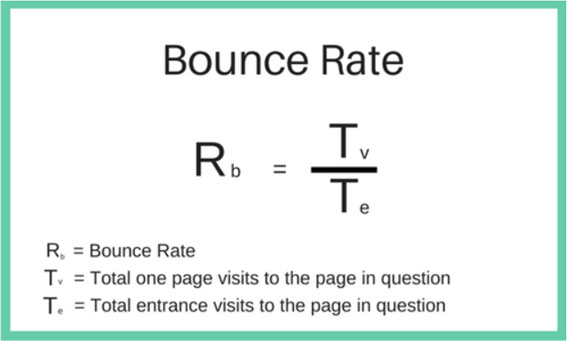
Image Credit
However, low bounce rate is not always a direct sign that your site performance is endangered. This metric varies depending on the type of your website. Thus, the average e-commerce store should expect this metric to be somewhere between 20-40%, while bounce rate at 50-70% is eligible for a landing page as all essential information naturally is placed on one page. In that respect, visitors don’t need to click around the site to find the content they were looking for.
Nevertheless, the higher number may indicate serious issues with a website. The truth is that high bounce rate, along with low dwell time, can be a reason for Google to degrade your page in search engines as this means that the content doesn't correspond to the users’ queries.
Common reasons for high bounce rate include:
- Slow load time.
- Unfriendly design and navigation.
- The absence of inbound links.
- Bootless content.
- UX problems.
- Poor website aesthetics.
- Badly targeted keywords.
Taking these reasons in mind, you need to perform full-scale research to determine which aspect of your website has a crack in armor. In some cases, it is challenging to tackle it alone, especially if you are working with a complex CMS such as Magento. So I would recommend you consulting our developers to resolve all the issues and get more leads.
Page Load Time
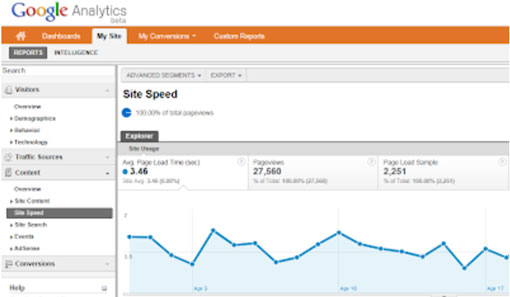
My list of the most important website analytics cannot be completed without a mention of the significance of speed. As for now, the internet users’ behavior is changing: they become demanding and less patient, they hate wasting their time waiting for a page to load.
According to the latest research, 53% of users abandon a site if its content takes over 3 seconds to load. Besides, Google also favors faster websites so reducing the number will lead to a surge in organic traffic.
This important KPI can be tracked right within your Google Analytics account.
Final Word
If you have never tracked website analytics before having a fright of all of those charts, numbers, and percentages, it is high time to do it. With the top tracking software, the data will be presented in a user-friendly way so that everyone can master it.
Consider this: tracking website analytics provide you with a true picture, rather than just taking wild guesses.
T
O
G
E
T
H
E
R